

Get started
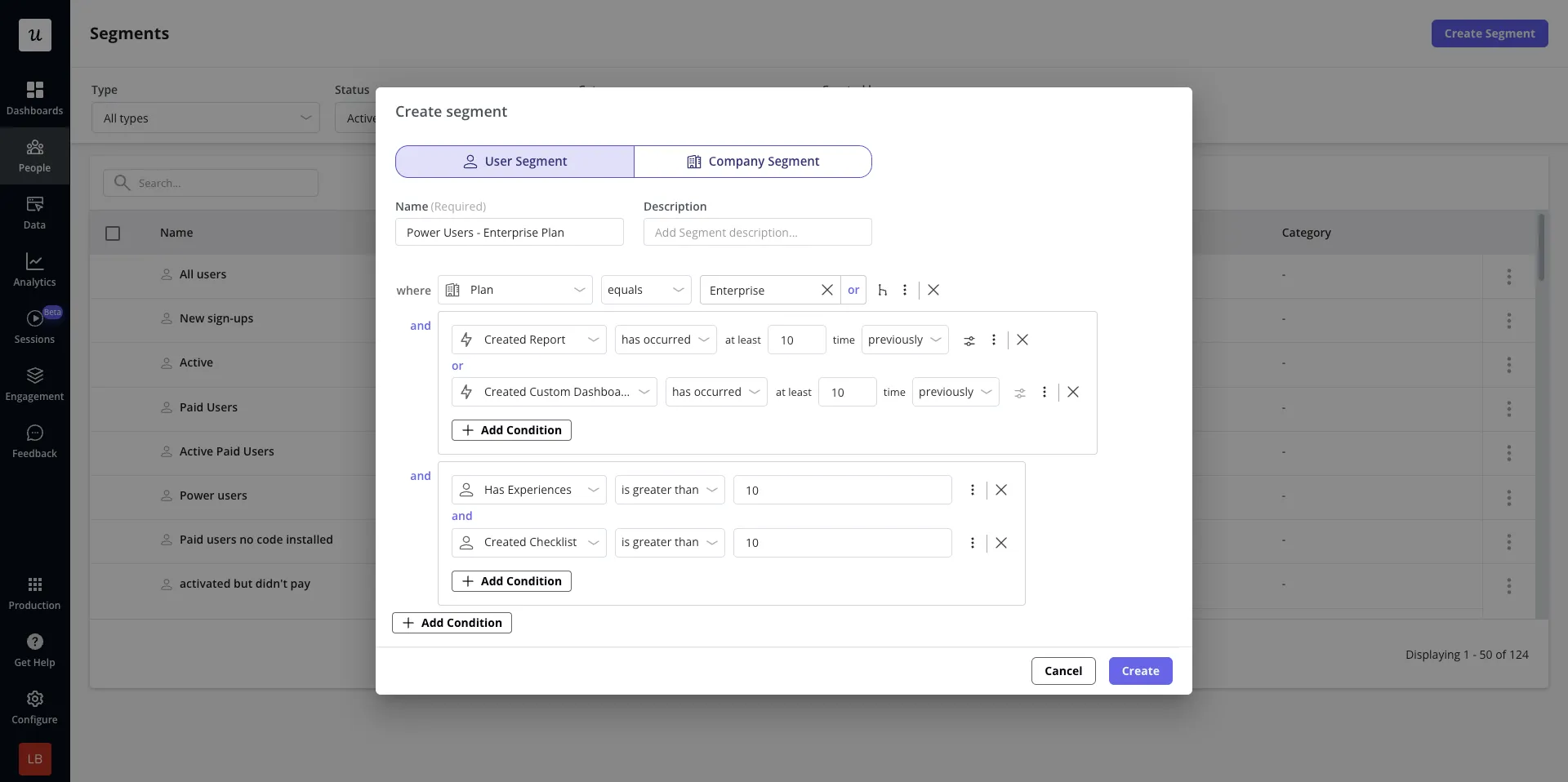
To begin creating User or Company segments, apply conditions from the User Overview or Company Overview page and click “Save Segment”. You can then access and manage your segments from the ‘Segment’ global filter directly on the User / Company Overview page, or navigate to Segments.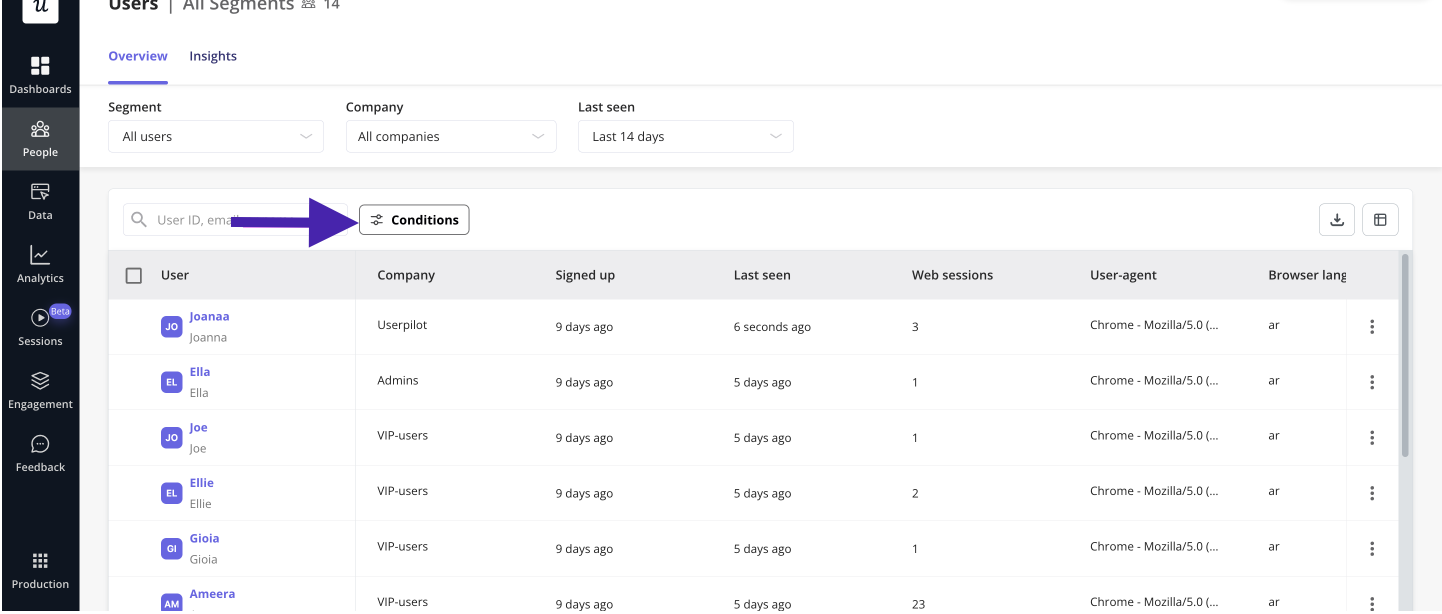
Conditions
Conditions help you narrow down user data based on different criteria. Userpilot offers several types of filtering options: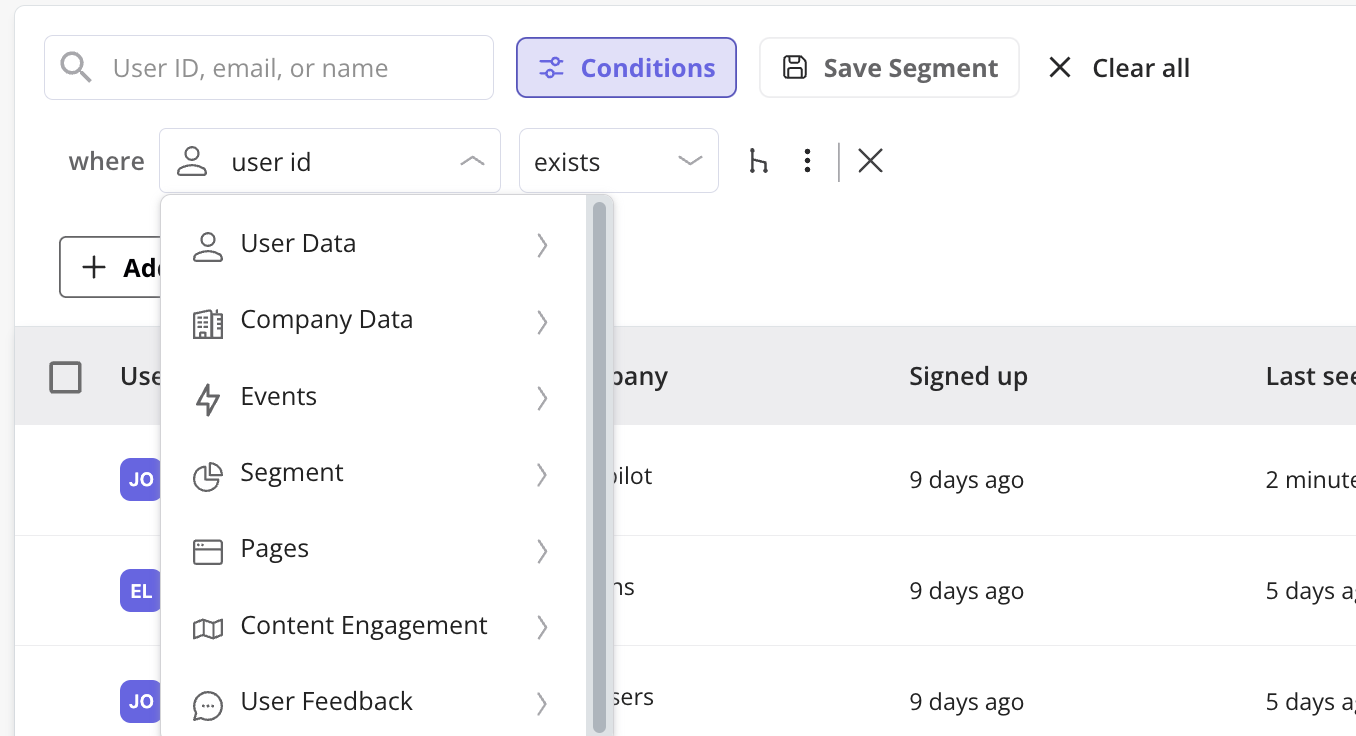
- the number of times an event was triggered (e.g. users who performed an event three times in the past week)
- custom event property data (i.e. filter tracked events by the custom property data attached to them - for more info on this, see Tracked Events Function)
- Checklists – Users who have started, completed, or dismissed a checklist
- Emails – Users who have received, seen or engaged with an email
- Embeds – Users who have seen a banner or a card
- Flows – Users who have seen, completed, dismissed or engaged with a flow
- NPS Surveys – Users who responded to or ignored an NPS surveys
- Spotlights – Users who have seen a spotlight
- Surveys – Users who submitted responses to or ignored in-app surveys
- Workflows – Users who have been enrolled or completed a workflow
- Flow form responses
- NPS responses
- Surveys
Understanding Logical Operators (AND vs. OR)
AND Operator
When you apply multiple conditions using the AND operator, all conditions must be met for a user/company to be included in the results
OR Operator
The OR operator surfaces users/companies who match at least one of the applied conditions.
- If filtering users who signed up in the last 7 days AND have a premium plan, only users matching both conditions will appear.
- If filtering users who signed up in the last 7 days OR have a premium plan, users meeting either condition will be displayed.
Logic Groups: Combining Multiple Conditions
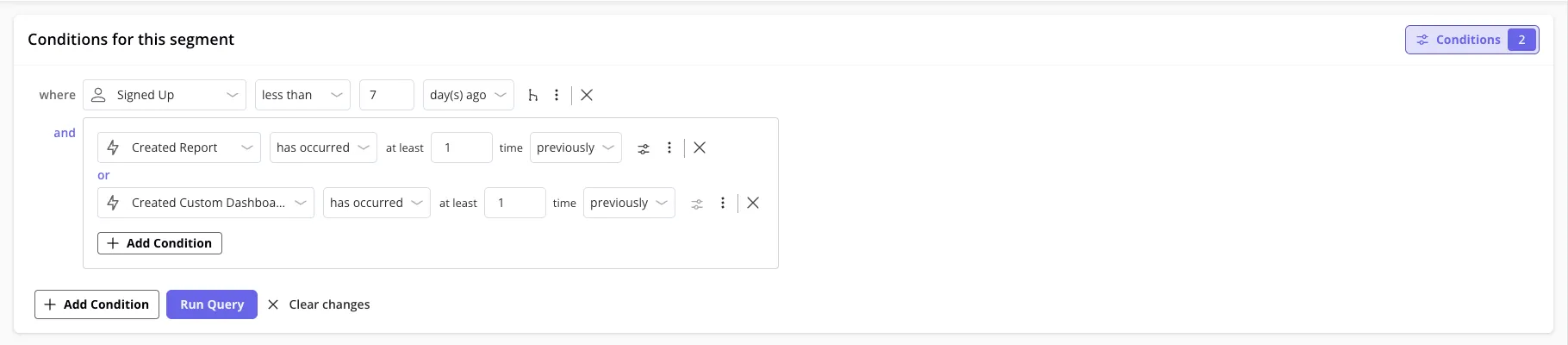
Logic Groups allow you to group conditions with the same logical operator for more advanced filtering. Example: If you want to filter users who signed up recently AND have created a report OR a dashboard, you can create a logic group:- Condition 1: Signed up in the last 7 days
- Condition 2: (Created report OR created dashboard)
Adding Multiple Values Using “OR”
Userpilot allows you to add up to 5,000 inputs within a single condition using the “Add Multiple Values” feature. This feature enables users to copy and paste a list of values (e.g., user emails, IDs) separated by a line break, making it easier to filter large datasets efficiently.
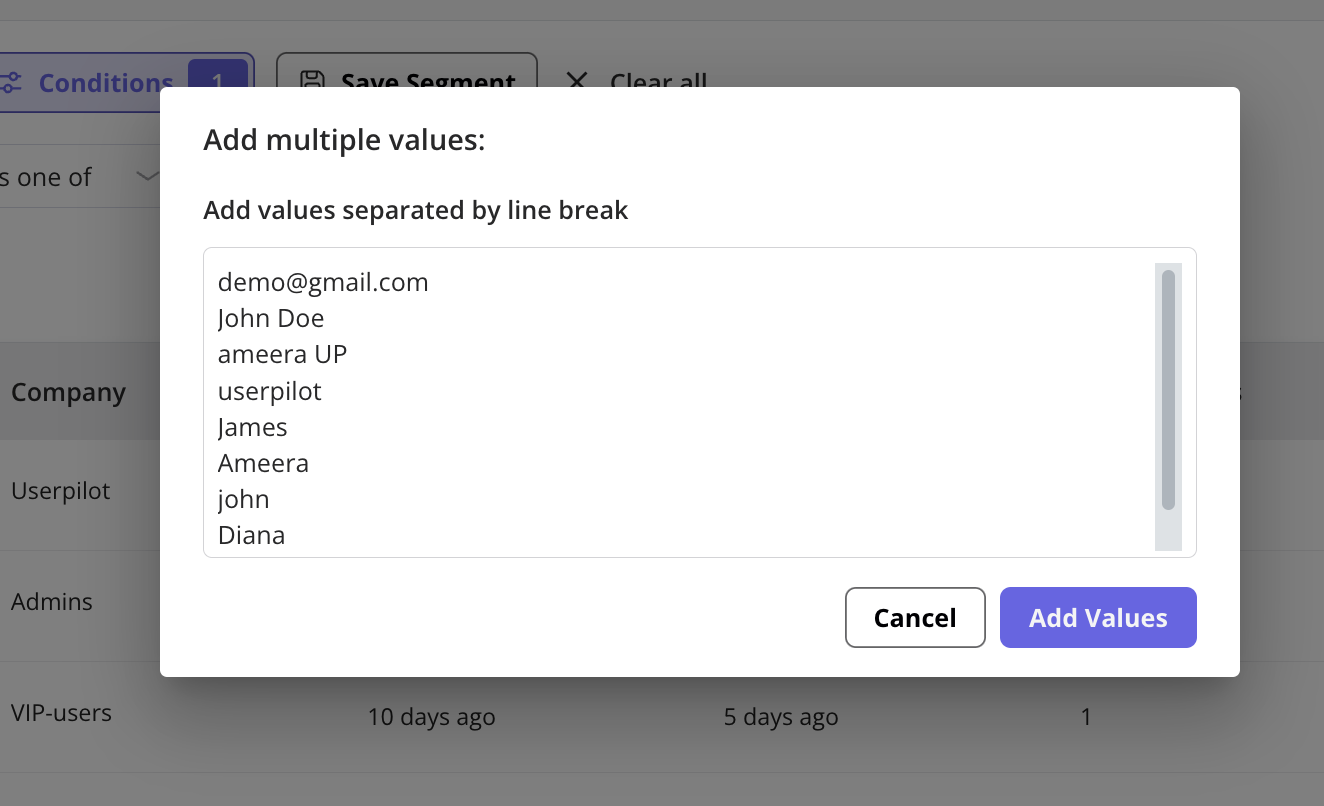
If you need to add more than 5,000 inputs, you can simply create an additional condition to accommodate the extra values.
Understanding Negative Operators
Negative operators (doesn't equal, isn't one of, doesn't match, doesn't contain, doesn't exist, and their boolean equivalents) include records that are missing the property entirely, not only those whose value fails the comparison. Positive operators (exists, equals, is one of, matches, contains) are strict and only return records that actually have a value.
This behavior is consistent across user and company properties, across string, date, and numeric data types, and applies both to segments on the Segments page and to segments used in triggering.
Quick reference
Example
Filtering users whose plan is not “Premium” withplan doesn't equal "Premium" returns users on other plans and users where plan was never set.
Excluding records that don’t have the property
For strictly negative conditions — only records that have the property set, with a value other than the one you’re excluding — combineexists with the negative condition:
plan existsANDplan doesn't equal "Premium"→ users who have a plan, and that plan isn’t “Premium”.- For company properties, add
company existsto exclude users who aren’t assigned to a company.
FAQs
How do I know which segment a user belongs to?
How do I know which segment a user belongs to?
When viewing a user profile in the Users Dashboard, you can check their associated segments to see which groups they belong to.
What happens if I delete a segment?
What happens if I delete a segment?
Deleting a segment removes the saved conditions, but user data remains intact.
How often are filters and segments updated?
How often are filters and segments updated?
Filters update in real-time, so any new users meeting the conditions will appear automatically.
What is the difference between a filter and a segment?
What is the difference between a filter and a segment?
Filters are temporary queries used to analyze user data on the spot, while segments are saved groups that can be reused and applied to different features.
Can I import user data into a segment?
Can I import user data into a segment?
While Userpilot doesn’t support direct data imports, you can efficiently add a list of users by using the “Add Multiple Values” feature. Simply copy your list and paste it into the condition field, separating values with a comma or a line break.
Why does my 'doesn't equal' segment include users who don't have that property?
Why does my 'doesn't equal' segment include users who don't have that property?
By design, negative operators (
doesn't equal, isn't one of, doesn't contain, doesn't exist) include records whose property is missing entirely. If you only want users who have the property set but with a different value, combine exists AND doesn't equal X in the same segment.Why are users without a company appearing in my company-property segment?
Why are users without a company appearing in my company-property segment?
When you filter on a company property using a negative operator, users who aren’t assigned to a company are included — they cannot satisfy a positive comparison, so they fall into the negative result set. To exclude them, add a
company exists condition to your segment.Does this behavior apply only to the Segments page, or to triggering as well?
Does this behavior apply only to the Segments page, or to triggering as well?
It applies to both. Segmentation in the Userpilot dashboard and segment evaluation when triggering experiences follow the same rules, including for string, date, and numeric properties.