

Overview
Sessions in Userpilot give you a detailed view of how users interact with your product during a specific visit. Each session shows a user’s journey, including pages visited, features used, and engagement with in-app experiences.Use Cases
- Analyze user journeys: View detailed user interactions to better understand your product’s current experience.
- Make data-driven decisions: Leverage insights from session replays to improve your product.
- Optimize user experience: Identify friction points and enhance the overall user flow.
- Troubleshoot issues: Watch users as they experience bugs or errors to pinpoint problems and resolve them faster.
- Spot friction and errors automatically: Identify sessions with frustration signals or technical errors without watching every recording.
Get started
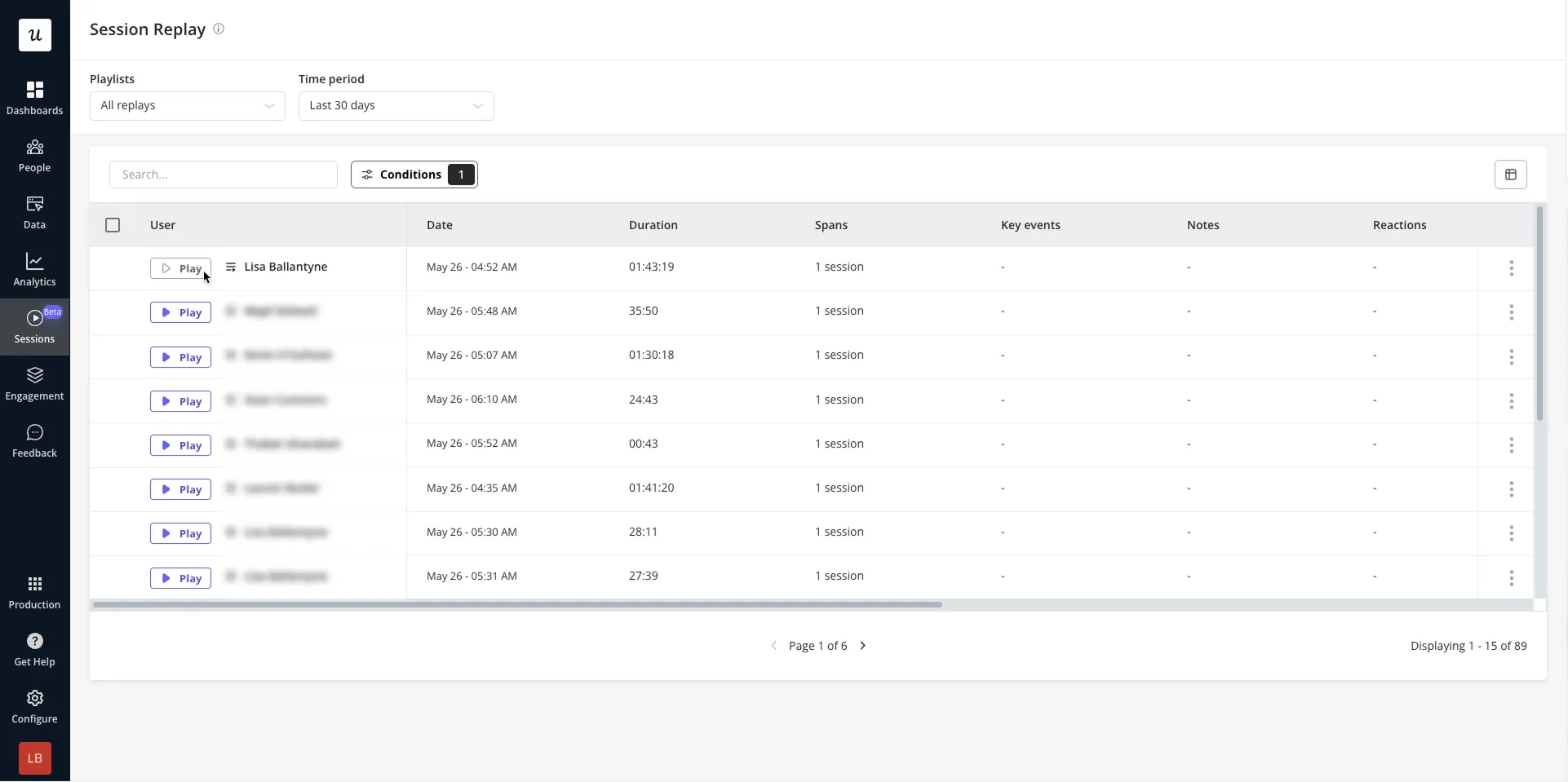
To get started, simply navigate to the Sessions tab here, you’ll see a list of recent sessions that you can filter by user, date, or event activity to begin analyzing user journeys effectively.Filter sessions by conditions
To narrow down the sessions that surface within the table, specify conditions that you’re particularly interested in.- User & company filters: narrow down sessions based on specific user or company attributes. This is especially useful when you want to analyze the behavior of a particular user or group of users — like users on a free trial, those from a specific company, or users tagged with a certain role.
- User data — name, email, user ID, or any custom user attribute
- Company data — company name, plan, or any custom company attribute
- Segments — any user or company segment you’ve already built
- Key event filters: quickly find sessions where important actions were taken. These filters help you focus on meaningful interactions and understand the context in which key actions occur, making it easier to troubleshoot issues or optimize user flows.
- Events — whether a specific labeled or tracked event has occurred
- Frustrations — whether a frustration signal occurred, such as a rage click, dead click, error click, u-turn, or form abandonment
- Pages — whether a specific tagged page has been viewed
- Performance — whether a technical issue occurred, such as a console error, network error, or uncaught exception
- Content engagement — whether a piece of in-app content (flow, banner, checklist, etc.) was seen, completed, or dismissed
Frustrations & Performance signals - How it's detected
Frustrations & Performance signals - How it's detected
Frustration signals
- Rage click — 3+ clicks on roughly the same spot on the screen within ≈ 1 second
- Dead click — a click on something and the page doesn’t react: no content change within 2.5 seconds, and no scrolling, text selection, or tab switch in the half second right after the click.
- Error click — a click where the app crashes with a JavaScript error within 1 second. Only genuine app crashes count — not warnings developers log or failed network requests. If a click causes a crash, we report it as an error click only (not also as a dead click), so one moment of frustration is never counted twice.
- U-turn — The user lands on a page and, within 3 seconds, goes back to the page they came from
- Form abandonment — at least one field is modified, then the user leaves without submitting — by navigating to another page, closing the tab, or going idle for 30 minutes.
- Console error — The app’s developers logged an error message to the browser console. These are handled problems the app noticed and reported itself. Kept fully separate from crashes (below).
- Network error — A request the app made to a server failed outright or came back with an error status (4xx client errors or 5xx server errors). Redirects and successful responses are not counted.
- Uncaught exception — The app crashed with an error nobody handled (including failed background operations) - tracked separately from console errors
- Session filters: narrow down sessions by properties of the session itself — like duration, event count, or whether a teammate has flagged it. This is especially useful for filtering out low-value recordings (like mostly-idle sessions) or jumping straight to ones your team has flagged as bugs, frustrations, or satisfaction moments.
Viewing errors & frustrations at a glance
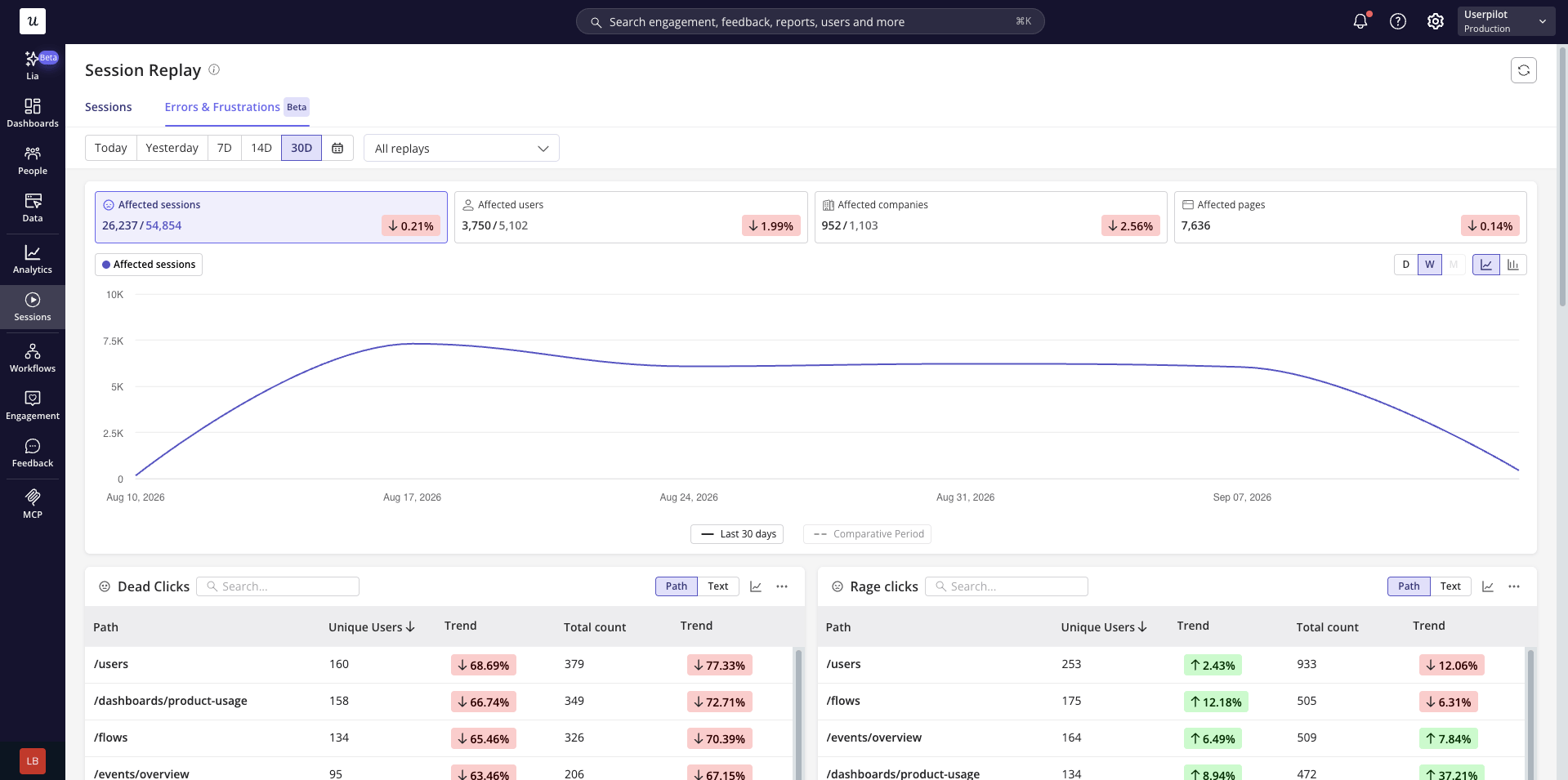
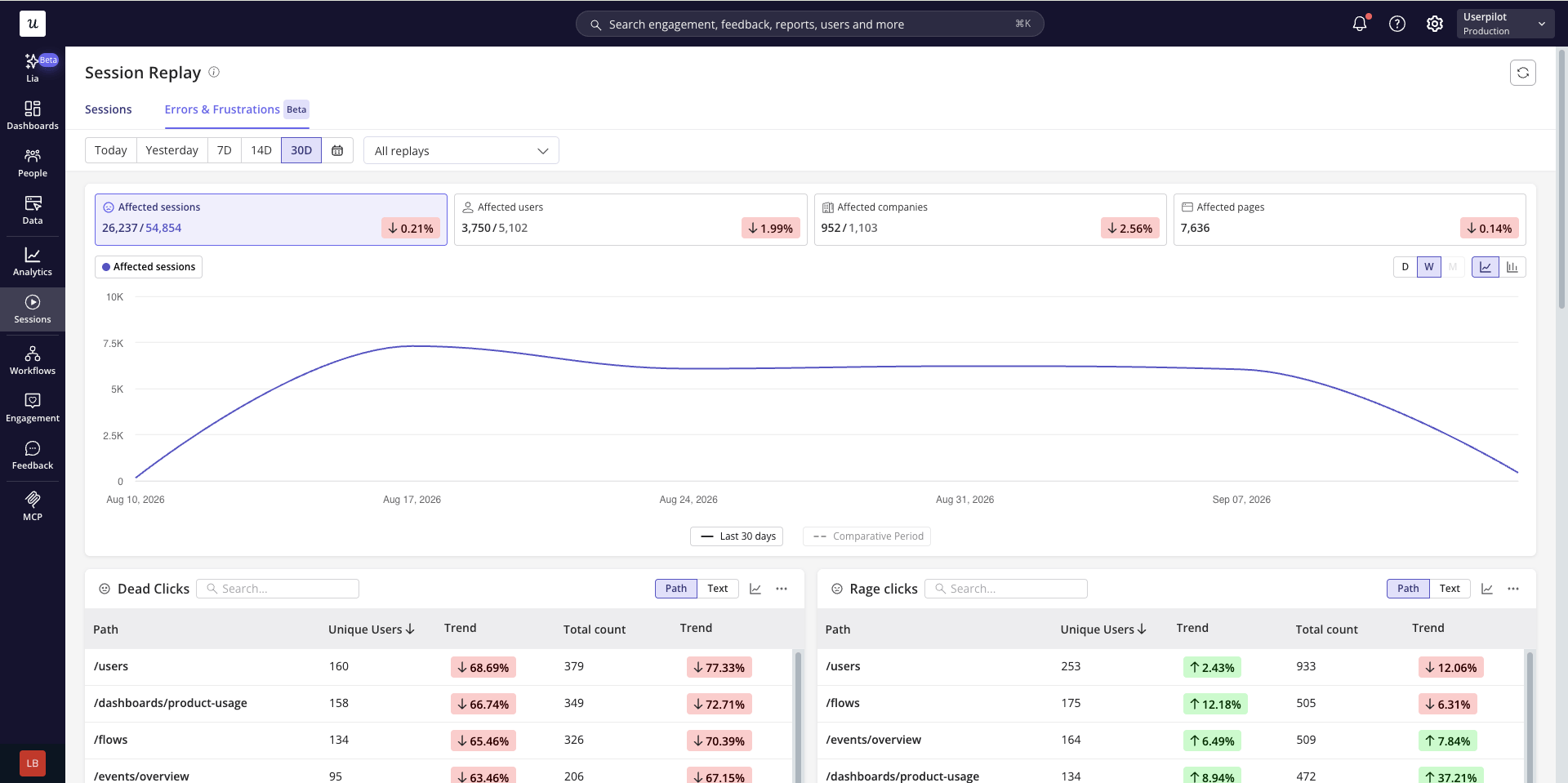
- If you’d rather see the bigger picture before diving into individual replays, head to the Errors & Frustrations page — accessible either from the Sessions section of the left navigation, or via the ‘Errors & Frustrations’ tab in the Session Replay page header.
- It pulls together frustration and performance signals across your entire product, not just the sessions you’ve replayed, so you can spot where users are struggling before watching a single recording.
Playlists
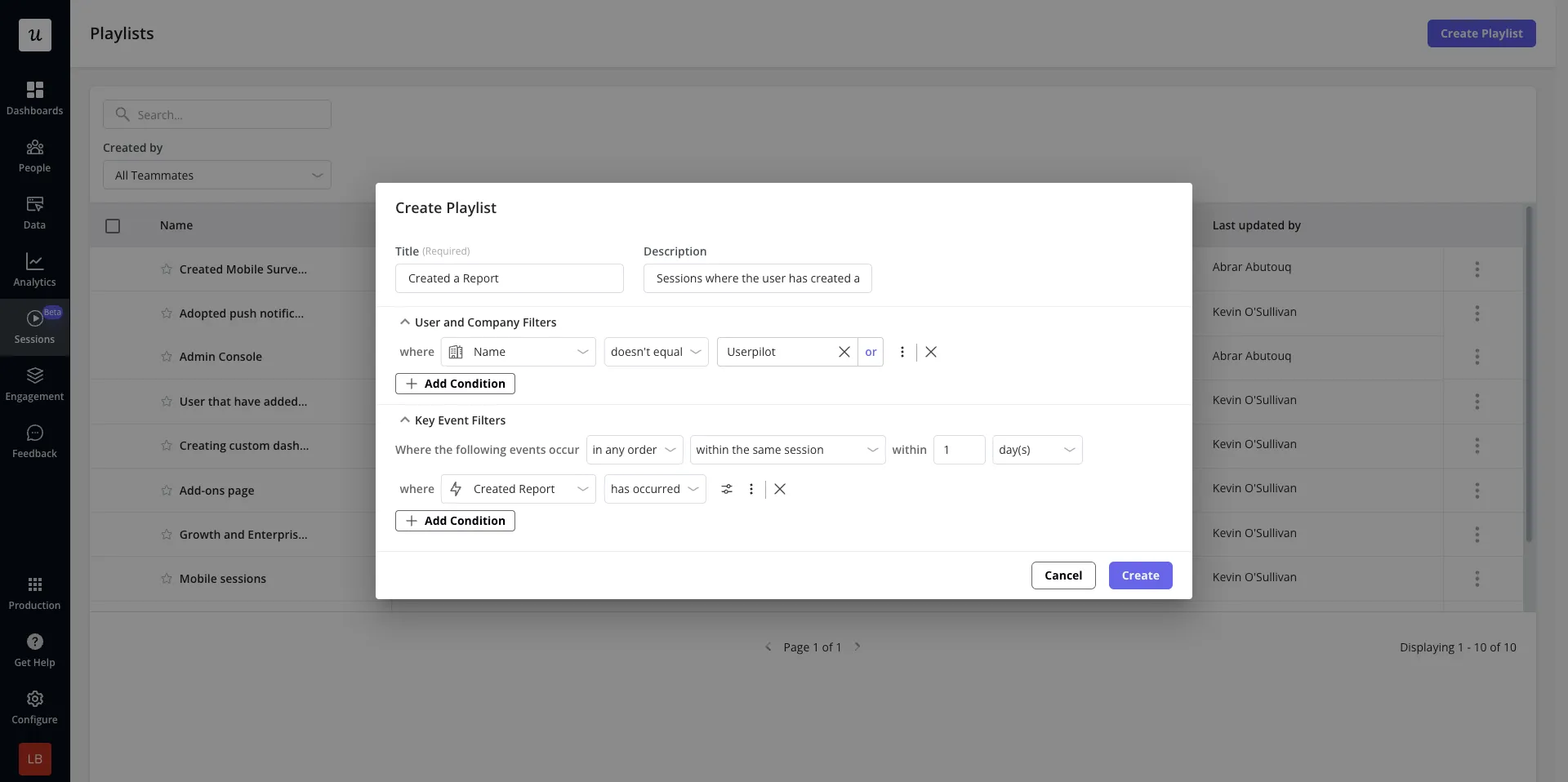
- After using filters to target the users / events you care most about, Playlists allow you to save your conditions so that you can access the sessions you care about more easily. Simply click ‘Save playlist’ once you’re happy with your conditions. You can then access and manage your playlists from the ‘Playlists’ global filter directly on the Session Replay page, or navigate to Playlists. Every account also comes with three default playlists — Bug flagged, Frustration flagged, and Satisfaction flagged - which populate whenever a teammate reacts to a session with that flag.
Watching a Session
When you open a session in Userpilot, you’ll see a built-in video player that visually replays the user’s journey step-by-step. The player includes helpful controls to:- Jump forward/back 10 seconds
- Adjust playback speed
- Leave a note: Attach a note at a specific point in the replay or to the entire session to provide additional context. This allows you to highlight important observations or flag issues for future reference or team collaboration.
- Quick react: Choose from icons that represent a bug, satisfaction, or dissatisfaction to efficiently note and communicate your end-users’ behavior within the replay’s timeline.
- Skip inactivity: Have the replay fast forward through times the end-user wasn’t active within the session.
- Dev tools: Open a console and network log panel showing everything captured during the session — filter by errors, warnings, or failed requests, search by keyword, and click any entry to jump the player to that exact moment.
Session Replay Privacy Settings
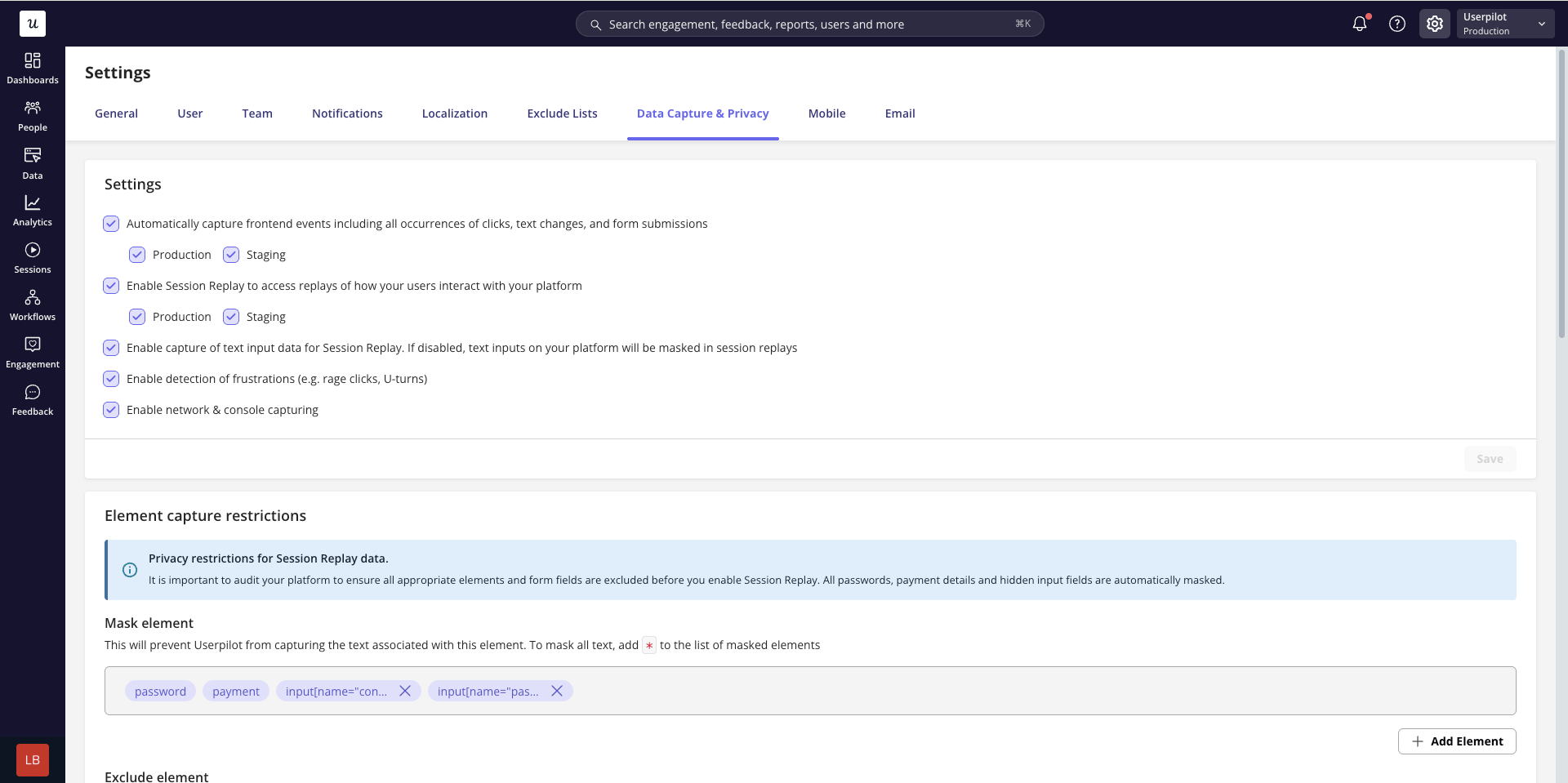
You can control which data is captured during user sessions through Data Capture & Privacy Settings. From here you can control:- General Session settings:
- Turn on/off session replay: disable the feature completely
- Specify the environment: Enable session replay in your staging or production environment, or in both. Enabling only in your staging environment allows you to test out the restrictions before they apply live
- Enable/ disable capture of text input data: If disabled, all text inputs on your platform will be masked in session replays.
- Enable detection of frustrations: turns on automatic detection of frustration signals (rage click, dead click, error click, u-turn, form abandonment).
- Enable network & console capturing: turns on dev tools access and detection of performance events (network error, console error, uncaught exception)
- Element capture restrictions:
- Masking elements will prevent Userpilot from capturing the text associated with this element.
- Excluding an element will prevent Userpilot from capturing all information associated with this element.
- Excluding an attribute prevents Userpilot from capturing that specific attribute across elements.
- Data capture restrictions:
- Restrict the data that Userpilot automatically captures by specifying specific domains or locations to exclude - applied to both Raw Data and Session Replay data.
- Specify elements or paths where specific frustration or error interactions should be ignored as expected behaviour.
- Session replay restrictions:
- Restrict the data that Userpilot shows in Sessions by specifying specific segments to exclude - applied to Session Replay data only.
FAQs
Can I delete a session?
Can I delete a session?
Yes - simply click the more action menu on the row of the session you’d like to delete.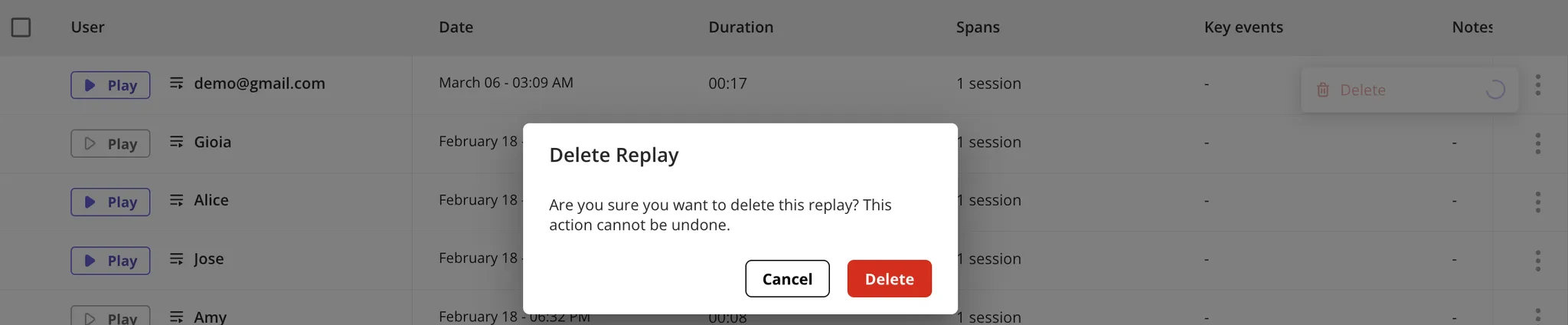
How do you handle retention?
How do you handle retention?
Session replay retention depends on your plan. On Starter, Trial, Growth, and Enterprise plans, replays are stored for 30 days from the time of capture by default (Growth and Enterprise can customize this window). Analytics data uses a separate window (default 3 years storage and reporting on Growth and Enterprise). See Data Retention for the full breakdown. If you need to delete replays containing sensitive data before they expire, you can do so as shown above.
What does 'Spans' in the sessions table refer to?
What does 'Spans' in the sessions table refer to?
The span column refers to how many sessions are in that specific replay - this will be dependent on the settings you’ve specified for the Key Events ‘Where the following events occur …’ input. If the key events are specified to occur ‘within the same session’ - the number of sessions the replay spans will always be 1. If the key events can occur ‘across any number of sessions’ - the number of sessions the replay spans could consist of more than one. 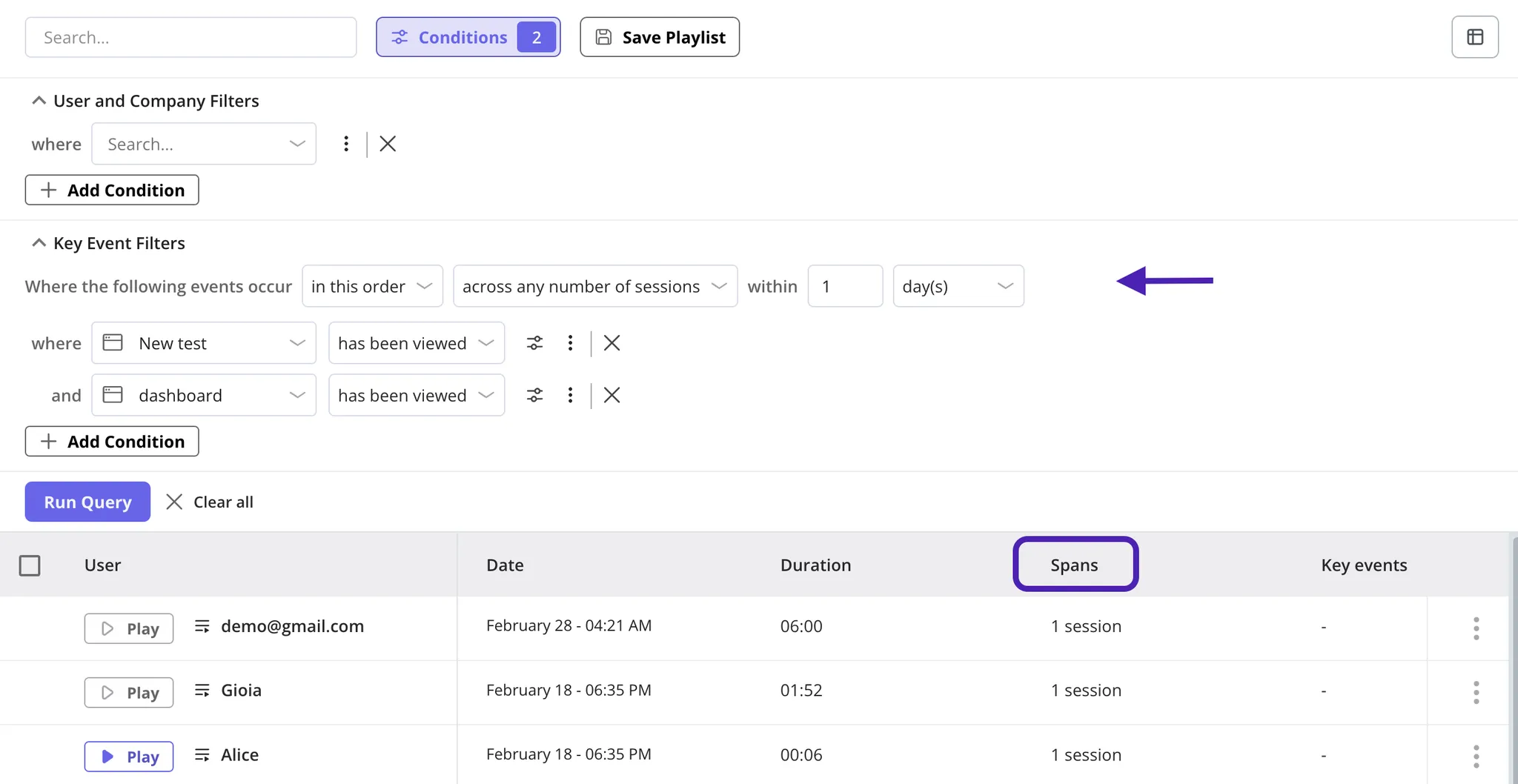
What do the 'Tabs' within the video player mean?
What do the 'Tabs' within the video player mean?
Userpilot can record multiple tabs that the user has open in their session. The tab that the user is active in at a specific time will be highlighted.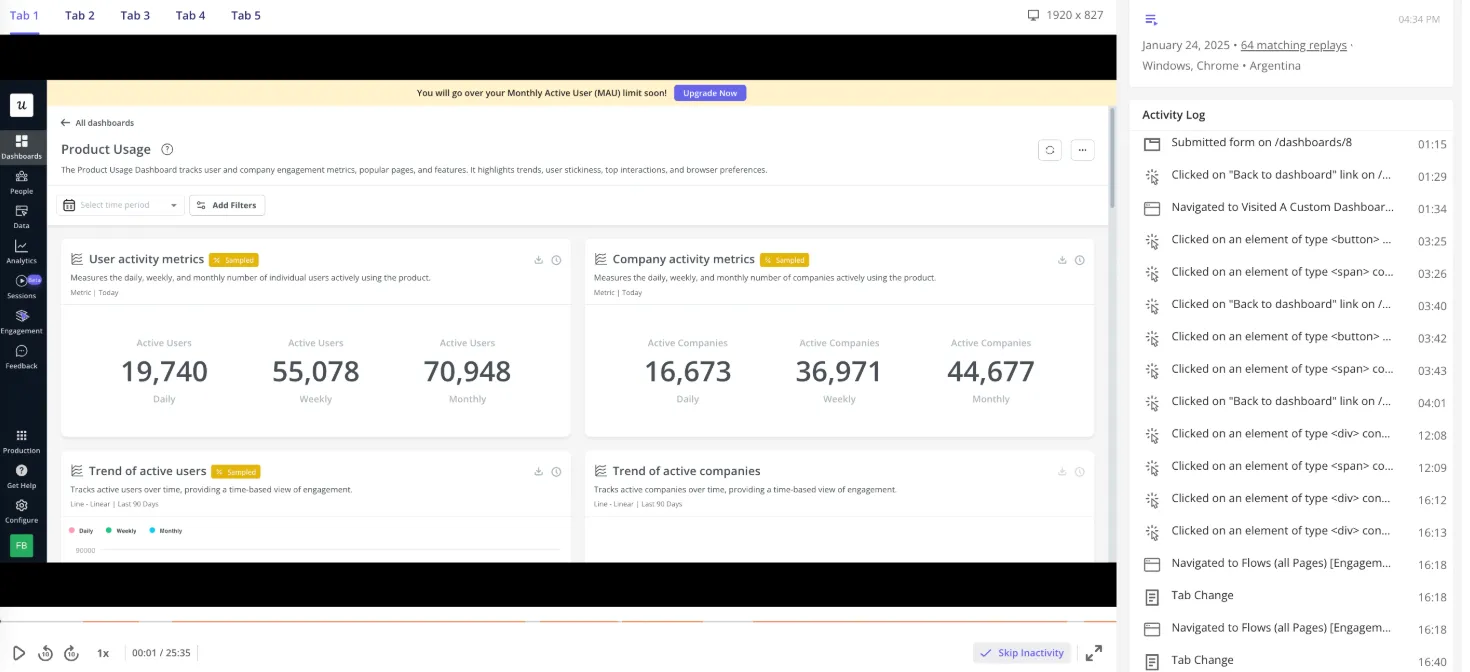
How do I prevent expected behavior from being flagged as a frustration?
How do I prevent expected behavior from being flagged as a frustration?
If a frustration or error signal is flagging something that’s actually expected behavior (say, a click that always looks like a rage click but isn’t a problem), you can mark it as an expected interaction from that event in the activity log. This stops that specific interaction from being detected as a signal going forward, across all future session replays — it won’t affect sessions already recorded. You can review, add to, or remove these rules at any time from Data Capture & Privacy settings.
For any questions or concerns please reach out to support@userpilot.com