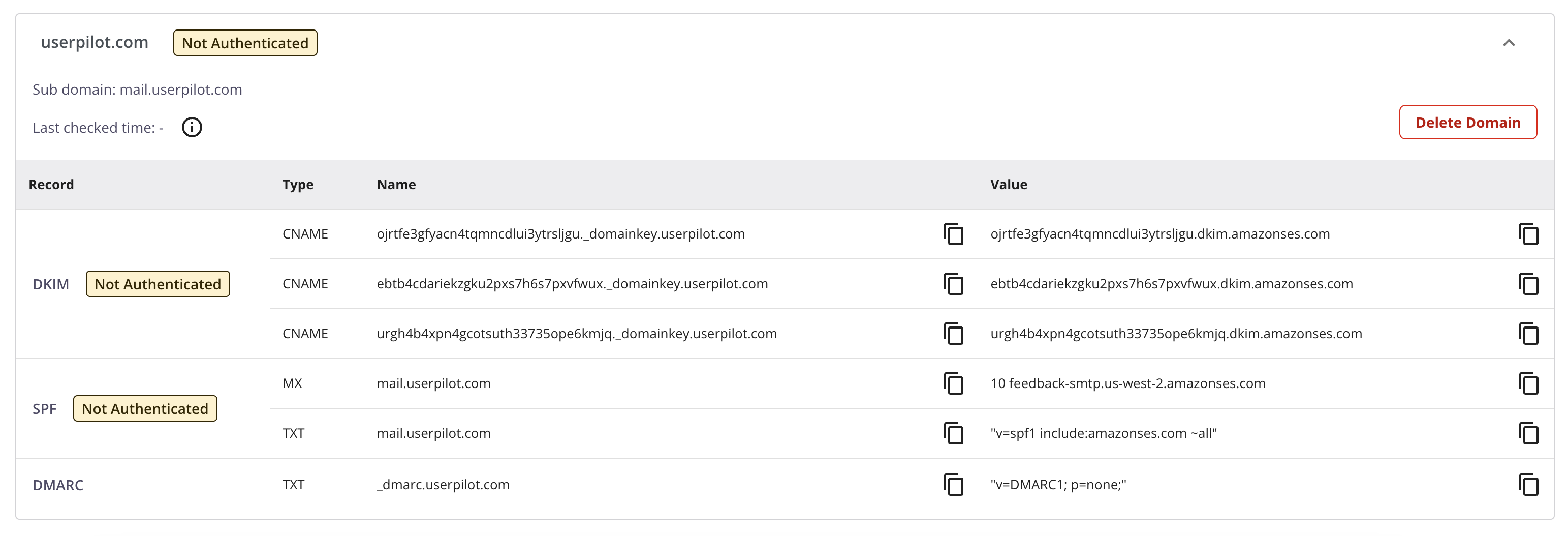
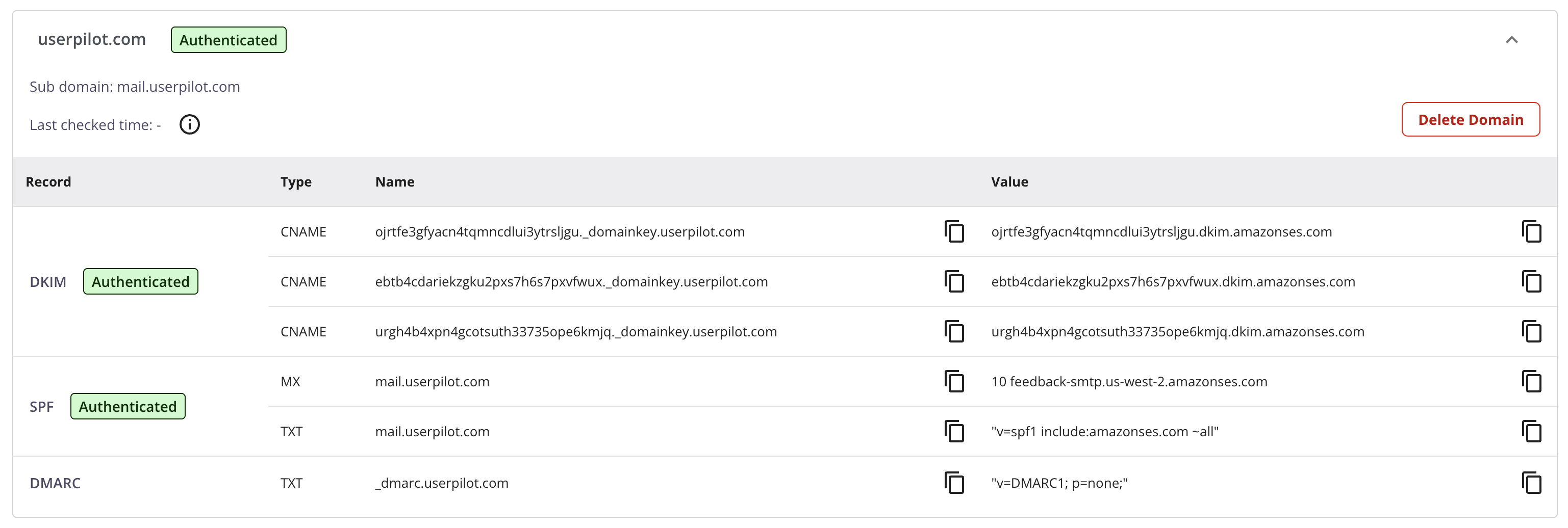
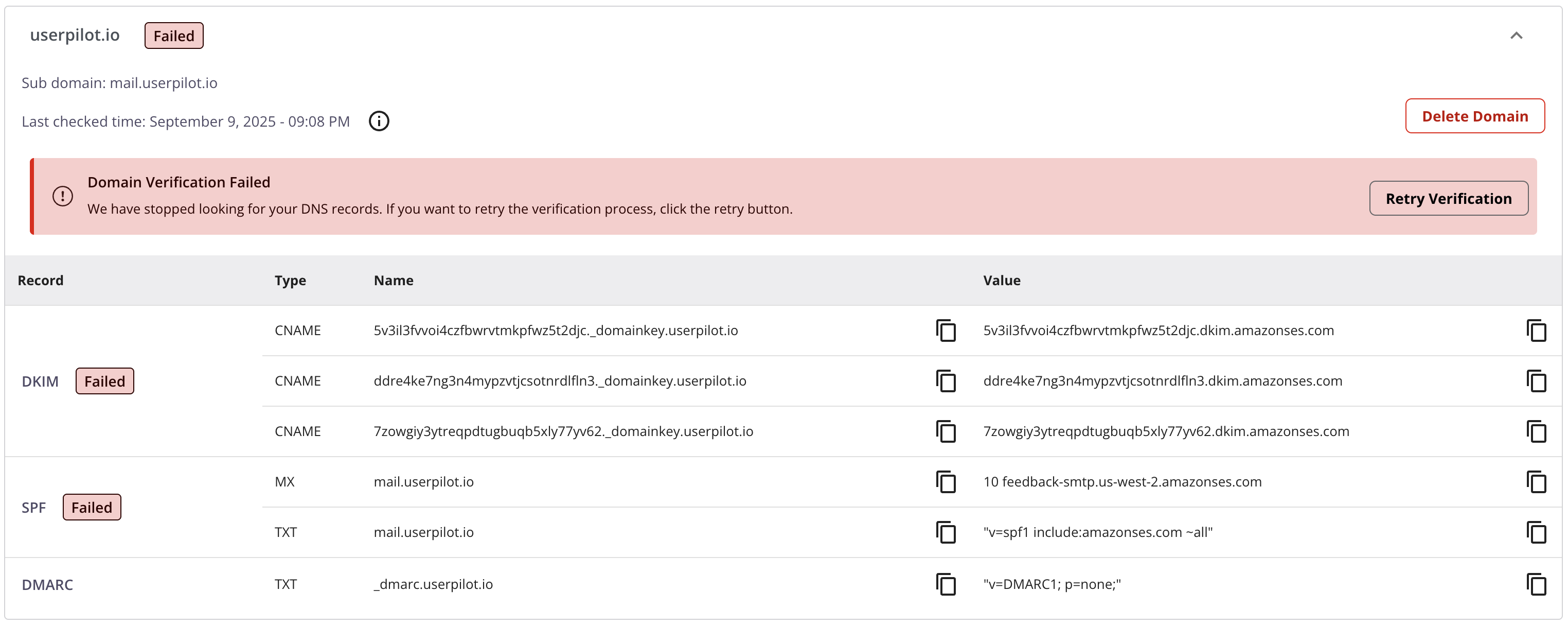
Domain authentication proves to email providers that Userpilot is allowed to send emails on your behalf. It’s required before you can send any emails, and it’s what keeps your messages trusted rather than flagged as spam.Once your domain is authenticated, you’ll:
Prevent spoofing - stop others from forging emails that appear to come from your domain.
Pass modern sender checks - meet the authentication requirements now enforced by Gmail, Outlook, and other major inbox providers.
Keep tracking links trusted - click links are served from your own domain, so they’re less likely to be stripped or flagged as suspicious.
DKIM: DKIM adds a tamper-proof signature to every email your app sends. Receiving mail providers check that signature against public keys in your DNS to confirm the message really came from you and wasn’t altered in transit.
SPF: SPF is an allow-list that Internet Service Providers use to check email authorization.
TXT Record → Authorizes our mail server to send emails on your behalf.
MX Record → A return-path which mail clients use to route bounces. Ensures block spoofing and keeps your main email (e.g., Gmail/Office 365) untouched.
DMARC: DMARC helps protect your domain from email spoofing by working alongside SPF and DKIM. It lets you define how email providers should handle messages that fail authentication checks and provides reports so you can monitor and improve your domain’s email security.
Note: You don’t need to add or adjust your DMARC TXT record if you already have one. Simply review it to ensure it meets your needs.
If you use Cloudflare, set all records to DNS Only. Proxying breaks verification.
Spam filters and recipient servers assess the root domain of email links to decide whether to trust an email, so using a domain you control significantly improves deliverability and reduces “suspicious link” flags.By default, Userpilot serves your email links with its own domain to track opens and clicks. With custom tracking domain enabled, those assets are served from your custom tracking subdomain instead (e.g., tracking.yourdomain.com). This keeps link URLs brand aligned and leverages your domain’s reputation for better inbox placement.
Email support@userpilot.com with the tracking subdomain you want to use (e.g. tracking.yourdomain.com). Make sure the subdomain is not used for other purposes.Userpilot will then provision the following resources for you:
SSL certificate.
CDN Distribution.
2
Verify the CNAME records
We will reach out to you once the resources are provisioned and ready to use. We will provide you with a set of CNAME records for both resources to add in your DNS provider.
3
Confirm the setup
Confirm to the support team that you have added the CNAME records. We will then configure the custom tracking domain for your emails.
Reach out to support@userpilot.com when you have verified the setup. We will then configure the custom tracking domain for your emails and confirm it with you.
You can find your Userpilot hosting region in the Environment page. If your HTTP endpoint is https://analytex-eu.userpilot.io/, you’re in the EU region.