

Overview
The Suppression List helps you maintain email deliverability, protect your sender reputation, and ensure compliance with regulations such as CAN-SPAM and GDPR. It automatically tracks and manages email addresses that should no longer receive emails from you for some reason.Get started
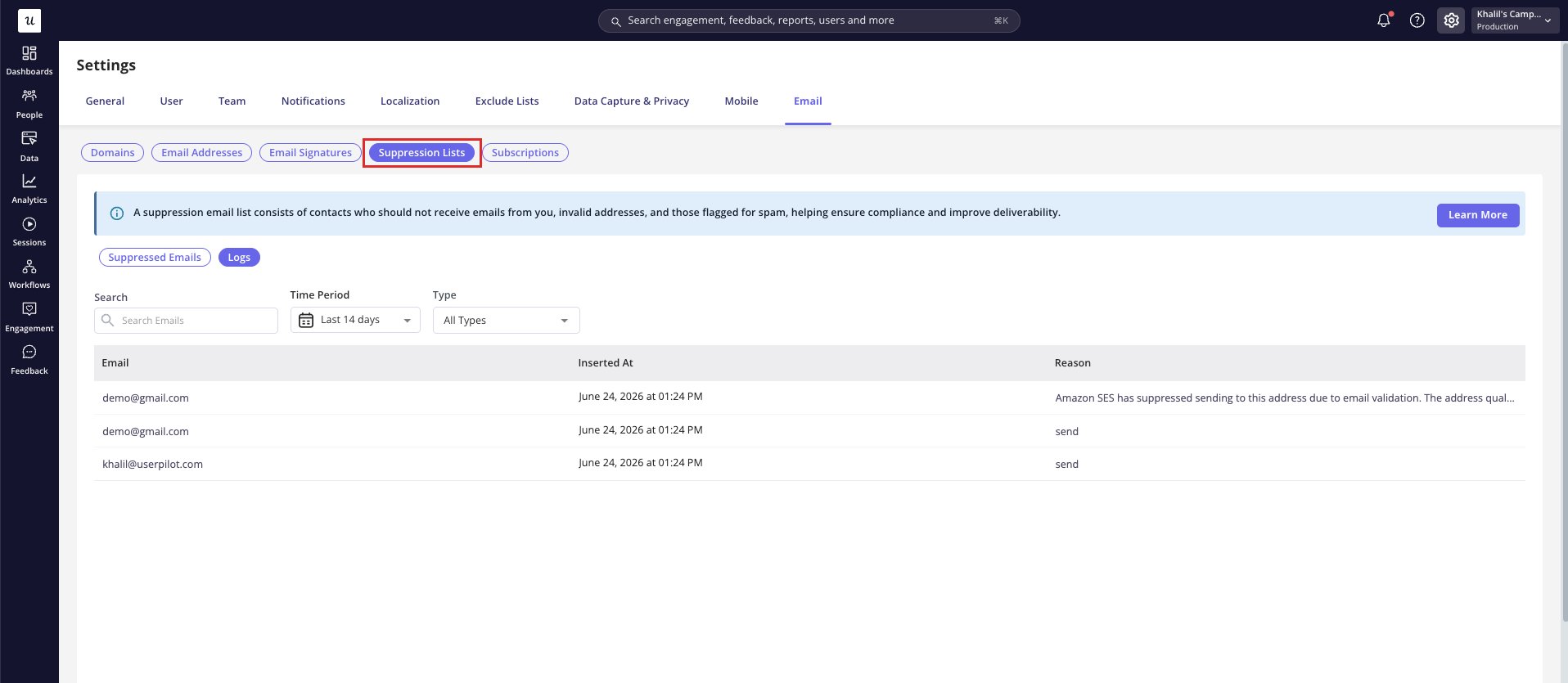
Click on Configure > Settings > Email > where you’ll find your Suppression list. Then you will see key details for each suppressed email:- Email: the address that was suppressed.
- Date: when the address was marked for suppression.
- Suppression Reason: why it was added to the list.
Userpilot automatically maintains a suppression list and prevents sending emails to addresses flagged for various reasons.
- If you try sending an email to an address on the suppression list, Userpilot will automatically block it to ensure compliance.
- You can’t manually add or edit email addresses. However, you can unsuppress addresses if needed.
Suppression reasons
Userpilot’s suppression list covers multiple reasons an email might be blocked from future sends: 1. User Opt-Out Users who clicked “unsubscribe from all emails” will automatically be added to the suppression list to respect their marketing preferences. 2. Hard Bounce (Invalid Email Addresses) These are addresses that can’t be delivered due to permanent errors:- Incorrect Email Addresses: Typographical or formatting errors.
- Non-Existent Domains: Domains that don’t exist or are unreachable.
- Repeated Mailbox Full: Addresses that consistently bounce due to a full inbox.
Why this matters
Maintaining a suppression list is essential for:- Compliance with regulations (e.g., CAN-SPAM, GDPR).
- Protecting your sender reputation.
- Improving email deliverability.
- Respecting your users’ preferences.
Bounce rate and email sending pauses: beyond suppressing individual addresses, Userpilot monitors your account’s overall bounce rate to protect your sender reputation. If your bounce rate climbs too high, email sending is automatically paused for your account until the issue is addressed.
- Keep your hard bounce rate low (aim for under ~0.5%). You can inspect which recipients are failing, and why, on the email Logs page by filtering Type > Hard Bounce.
- To get sending unpaused, follow Userpilot’s email warm-up plan: start with small batches to engaged users (recent Last Seen, moderate session counts), watch your bounce rate, then gradually increase volume.
- Repeated pauses escalate. A recurring pattern can lead to a longer pause (up to 3 months) or a requirement to integrate an email-validation service with your Userpilot user properties.